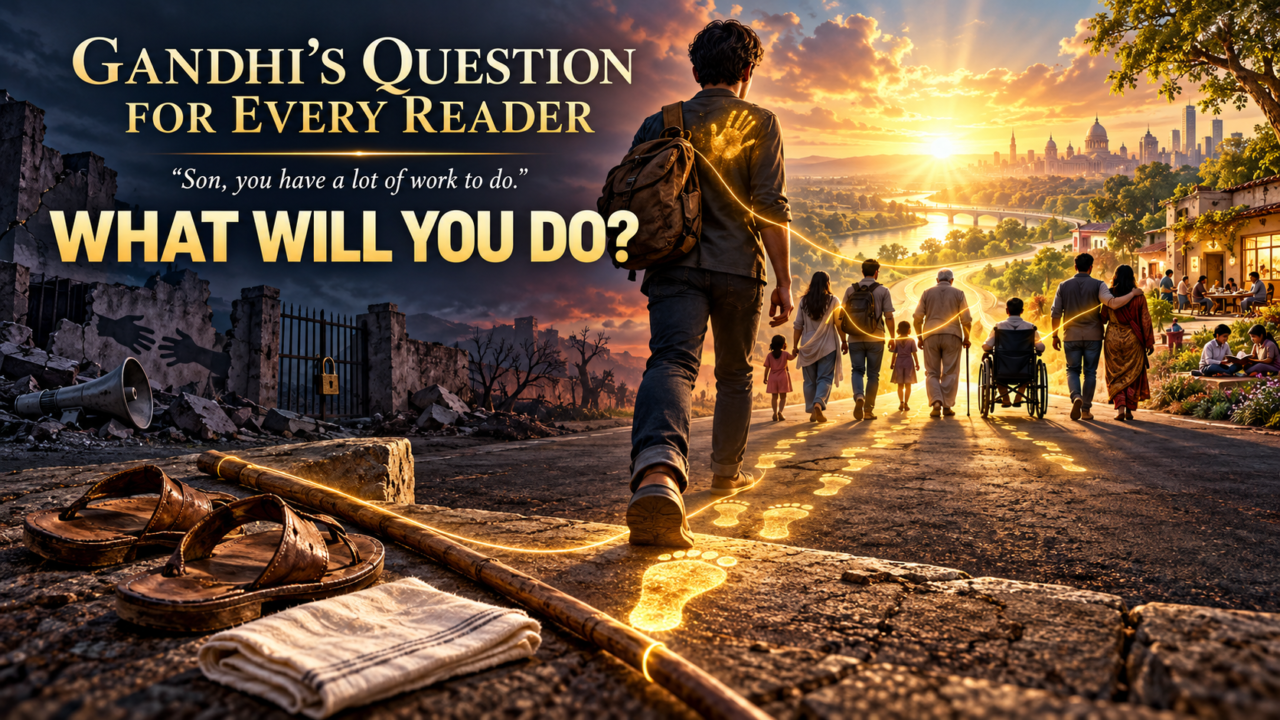
“Son, you have a lot of work to do,” Gandhi told me in a dream. What work does his legacy ask of each of us today?
By Dr. Mike Mohamed Ghouse
Founder and President, Center for Pluralism
Every October 2, the world remembers Mahatma Gandhi. We repeat his sayings, share his photographs and praise the nonviolent movement that challenged an empire. Yet remembrance has value only when it changes how we live.
On Gandhi Jayanti 2026 (Birthday celebrations), I find myself returning to a question more demanding than what Gandhi accomplished in his lifetime:
What work has his legacy left for us?
For me, that question is profoundly personal. Gandhi is among the people who have influenced my life most deeply. His language nourished reconciliation. His actions encouraged coexistence. Whether confronting British rule or tensions between Hindus and Muslims, he tried to move people beyond anger and toward solutions.
He demonstrated that power does not always come from wealth, weapons or authority. Sometimes it comes from refusing to hate.
The Moral Strength of a Selfless Person
Gandhi could have pursued comfort and professional success. He was educated in England and trained as a lawyer. Instead, he chose simplicity, service and solidarity with ordinary people.
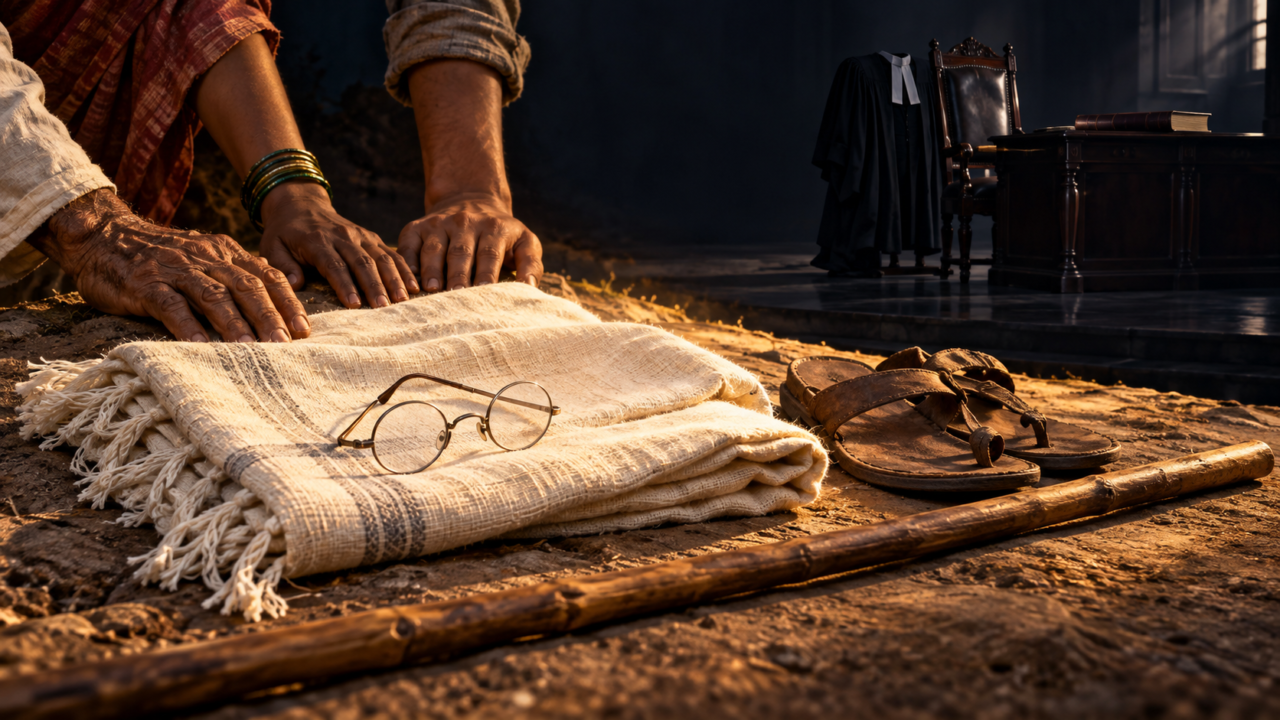
That simplicity was not a performance. It gave him moral credibility. People understood that he was not asking them to suffer for his advancement. He was prepared to endure suffering with them.
This is the source of a selfless person’s extraordinary strength. When people know that you seek no throne, title or personal reward, your words acquire a power that coercion cannot reproduce.
Gandhi’s nonviolence was therefore not cowardice or passivity. It was disciplined resistance. It challenged injustice without surrendering conscience. Violence may force an immediate result, but it often plants the seeds of retaliation. One injury demands another, and yesterday’s victim can become tomorrow’s aggressor.
Nonviolence tries to break that inheritance. It seeks justice strong enough to end oppression without creating another generation devoted to revenge.
Two Dreams and a Lifelong Calling
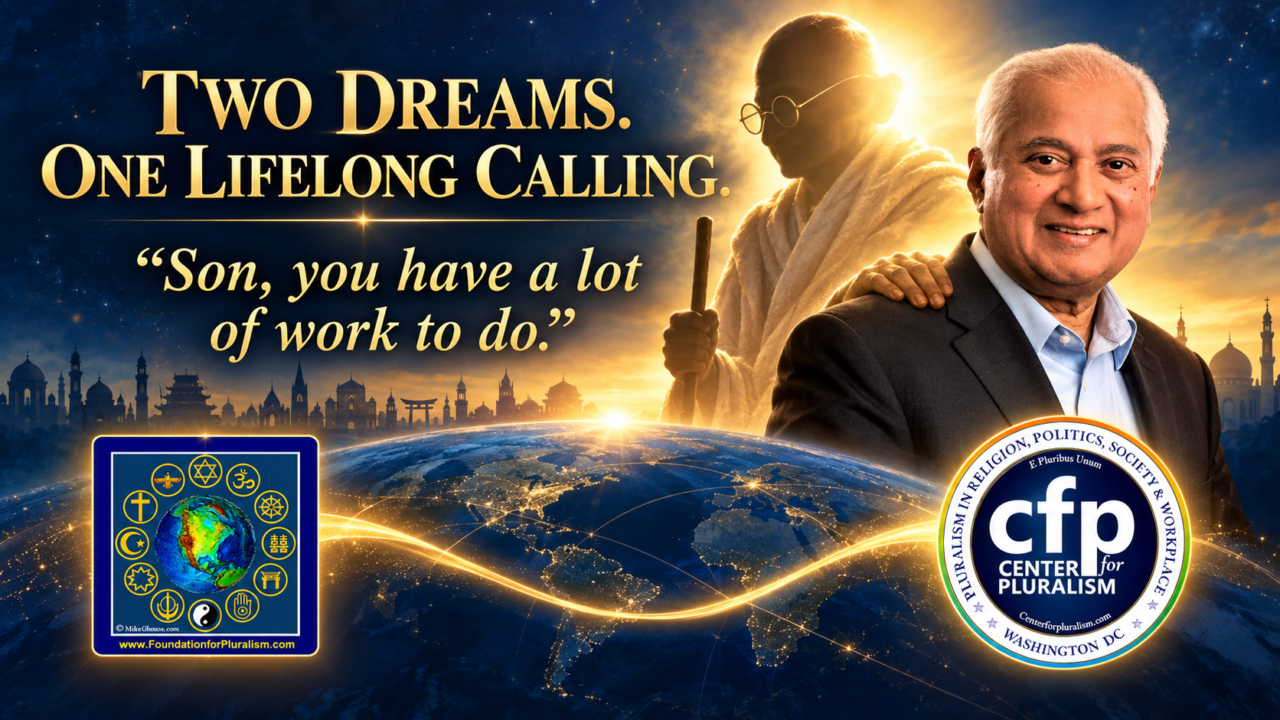
My relationship with Gandhi’s legacy became personal through two dreams, one in the early 1970s and another in the early 90s.
In both of those dreams, Gandhi placed his hand on my back and said:
“Son, you have a lot of work to do.”
I have never treated those words as a claim to special status. I received them as a responsibility.
What was the work?
For me, it meant helping build cohesive societies—communities in which people could live without fearing one another because of their religion, race, ethnicity, culture, political affiliation, sexual orientation or any other uniqueness.
That calling eventually found institutional expression in the Foundation for Pluralism, which later became the Center for Pluralism. Its purpose is not to erase differences or compel people to agree. Pluralism asks something both simpler and more difficult: that we respect the otherness of others and accept the uniqueness of every human being.
When we learn to do that, conflicts begin to fade and solutions emerge.
The work Gandhi spoke of in my dream was never mine alone. It belongs to anyone willing to replace suspicion with understanding, inherited prejudice with independent thought and hostility with a search for justice.
Before Nonviolence Becomes an Action, It Is a Language
We often imagine violence only in its physical form. But violence frequently begins much earlier—in the language we use about other people.
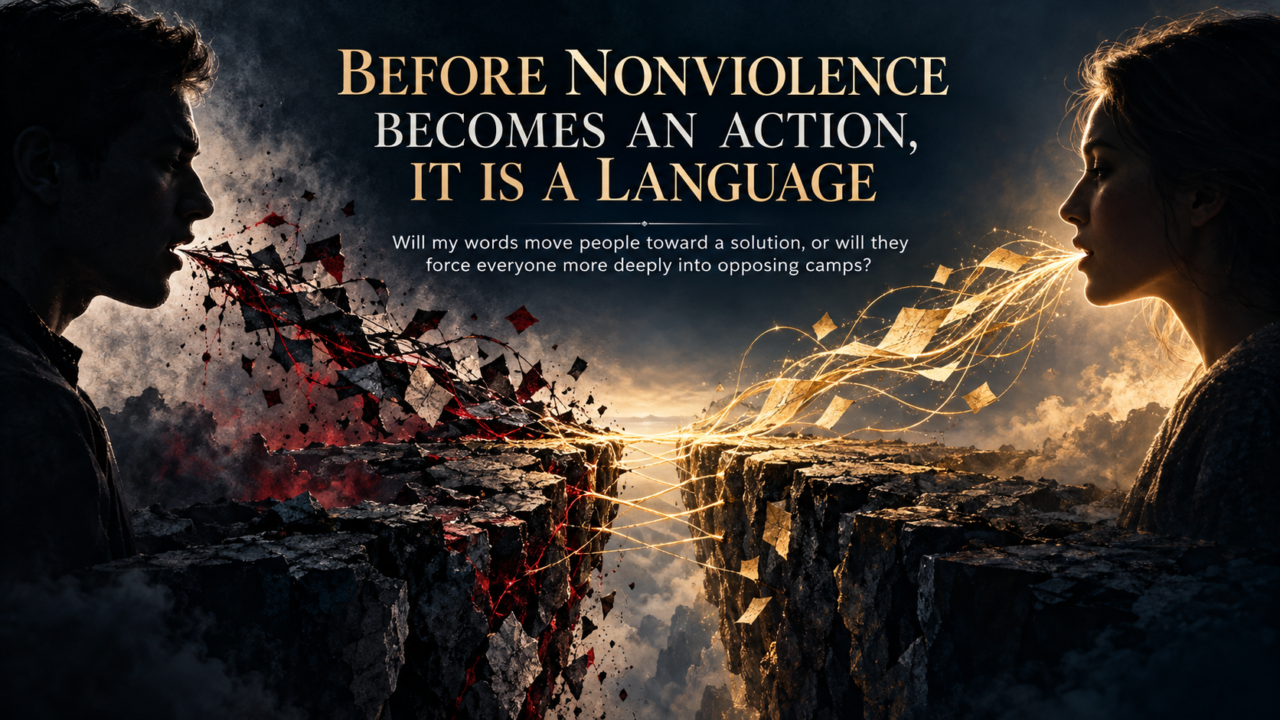
A careless sentence can turn a neighbor into a threat. A repeated stereotype can turn an entire community into a suspect. A political slogan can make cruelty feel patriotic. A religious label can be manipulated until discrimination appears righteous.
Before speaking, posting or forwarding something, we should ask:
Will my words move people toward a solution, or will they force everyone more deeply into opposing camps?
This question applies at home, at work, in politics, in religious spaces and across social media. Winning an argument while destroying the possibility of reconciliation is not a meaningful victory.
The better victory allows truth to be spoken, justice to be pursued and human dignity to survive.
Do Not Poison Your Children
Perhaps the most important work before us begins with how we raise our children.
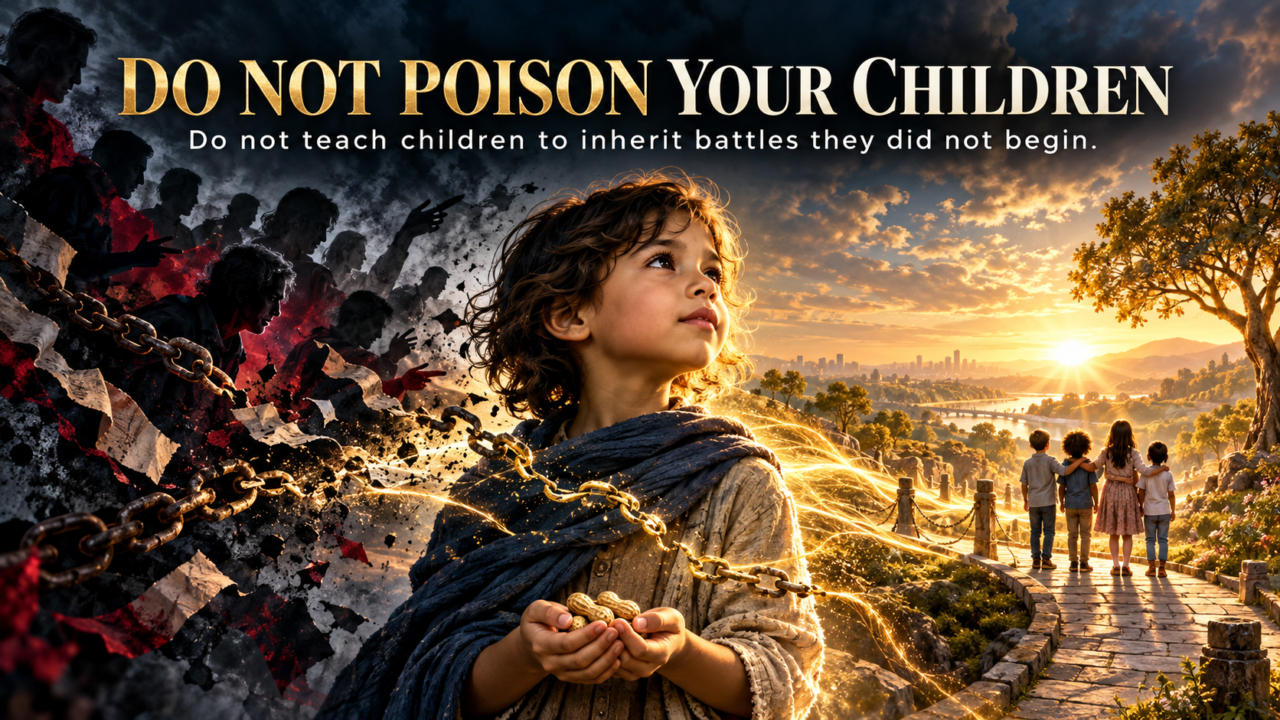
No child is born hating a Hindu, Muslim, Christian, Jew, Sikh, Black person, immigrant, gay person or anyone else. Children learn whom to fear—and whom to respect—through the words, reactions and examples of the adults around them.
Parents may believe they are protecting their children by warning them against another community. In reality, they may be burdening them with distrust, insecurity and an inability to live peacefully in a diverse society.
Our children will study, work, travel, form friendships and build families with people whose beliefs and backgrounds differ from theirs. Why make their future more painful by filling their minds with inherited enemies?
The influence of one’s environment extends beyond prejudice. It shapes the smallest habits, our understanding of fairness and even what we accept as normal.
I witnessed this when I took my children to India for the first time. As we walked along a street, people around us—including other children—were eating mungphali, or peanuts, and dropping the shells onto the ground. My children were eating peanuts too, but they held onto their shells instead of throwing them into the street.
Their response was not evidence that children in one country are naturally more responsible than children in another. It revealed something more important: children imitate the standards their environment consistently places before them. What they repeatedly see adults and institutions tolerate can gradually become normal. What their surroundings teach them to respect can become part of their character.
I learned the same lesson during a visit to the Taj Mahal. The line was extremely long. A man standing near the front approached us and offered to surrender his place for fifty rupees. I was prepared to accept his offer, but my children immediately objected.
“No, Dad. That isn’t fair. We will wait.”
Their response made me feel ashamed. In that moment, my children reminded me of a principle I already knew: convenience does not make an unfair act right. The lesson I had hoped to teach them had become the lesson they taught me.
These experiences showed me that children are always learning—not merely from what we tell them, but from what they watch us excuse, reward and practice. If an environment can teach a child to litter, disregard a line or accept an unfair advantage, it can also teach a child to distrust people of another religion, race, culture or identity. But the reverse is equally true: an environment can teach responsibility, fairness, empathy and respect.
My father gave me such a lesson, and it has remained with me throughout my life. During communal violence in Jabalpur in the early 1960s, Hindus and Muslims were killed, and entire communities were gripped by fear. My father insisted that individuals—not religions—were responsible for the bloodshed.
A religion cannot be arrested, tried or imprisoned. Justice requires identifying the person who committed the crime and holding that individual accountable. When we accuse an entire faith or community, we enlarge the conflict, punish innocent people and make reconciliation almost impossible.
That lesson remains urgently relevant in 2026. Hold wrongdoers accountable, but do not manufacture collective guilt. Do not teach children to inherit battles they did not begin. Do not fill young hearts and minds with ill will, animosity and prejudice, and then expect them to build a peaceful society.
Peace and security do not emerge from poisoned minds. They begin when each of us refuses to pass the poison forward.
The best tribute we can offer Gandhi is to raise a generation that does not have to spend its adulthood recovering from the prejudices of its parents.
Read more at : Poisoning Your Kids: The Hidden Dangers of Passing Prejudice to the Next Generation
Gandhi at the Family Table
The work of pluralism is not limited to governments or grand public movements. It also unfolds quietly inside homes.
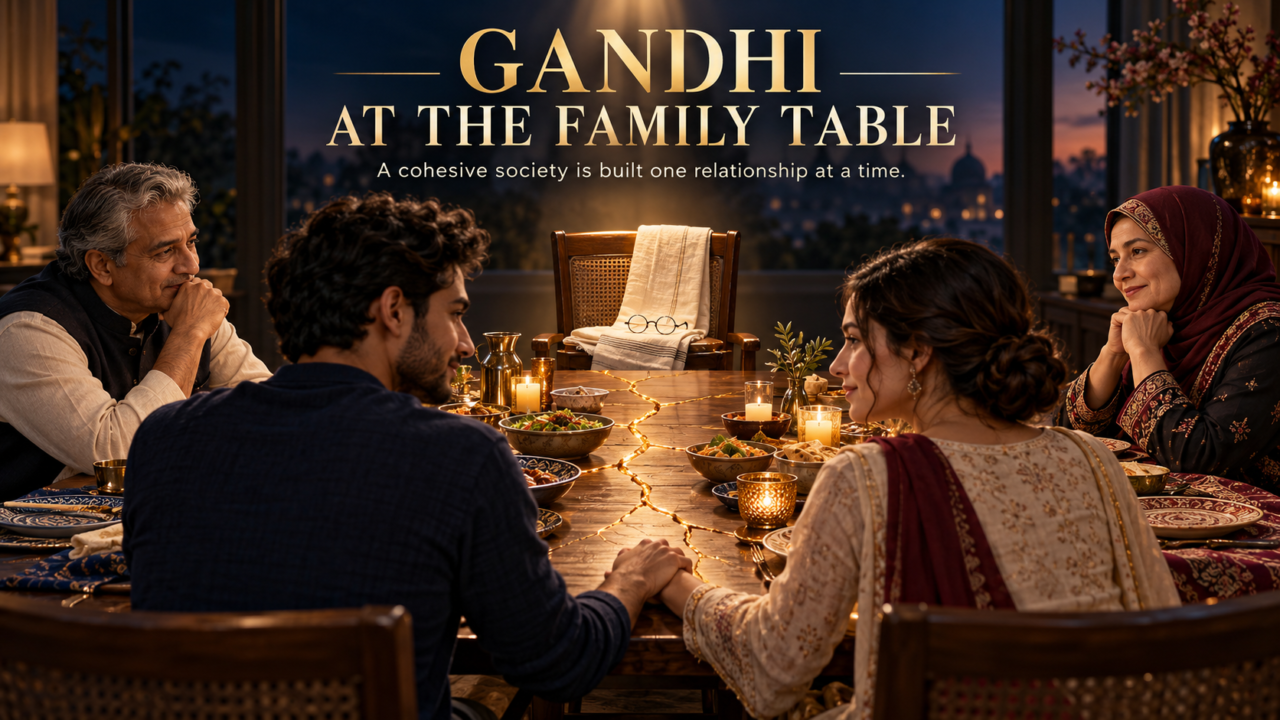
Through years of working with interfaith couples and officiating more than 650 interfaith marriages, I have sat with families struggling to accept the person their son or daughter loves. Hindu and Muslim parents often begin from opposite religious positions but express remarkably similar fears:
Will my child abandon our faith? Will our traditions disappear? What will our relatives say? How will the grandchildren be raised?
Fear speaks a common language.
The answer is not to ridicule parents or dismiss their concerns. It is to help families separate imagined losses from genuine ones. Respecting another tradition does not require erasing your own. Welcoming a son- or daughter-in-law of another faith does not make one’s family smaller. It can enlarge the family’s understanding of humanity.
This is where Gandhi’s legacy becomes intimate and practical. Nonviolence is not only how a nation resists an empire. It is also how a parent responds when a child makes an unexpected choice. It is how families remain in conversation when emotion urges them to withdraw love.
In Kolkata riots between Hindus & Muslims, a Hindu man comes to Gandhi and says “a Muslim killed my son and I want to kill his son”. Gandhi responds that find a Muslim child who is orphaned and raise him as a Muslim in your home.
It is an anecdote to remove prejudice which causes tension and pain and bring peace when we accept the otherness of others.
A cohesive society is built one relationship at a time.
Different Traditions, a Shared Moral Demand
I have drawn inspiration from Gandhi and from many of humanity’s moral teachers, Prophet Muhammad (PBUH), Jesus, Krishna, Buddha, Mahavira, Moses, Guru Nanak, Shamans and others.
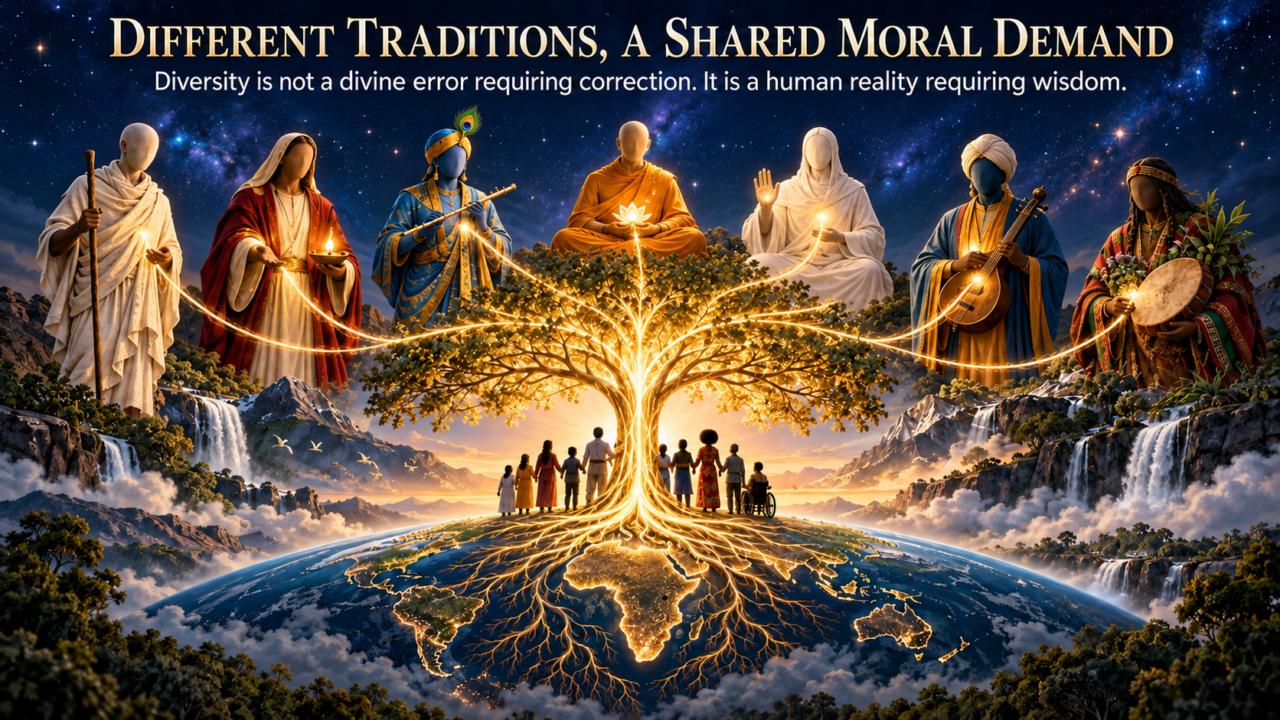
Their religious traditions are distinct, but a powerful ethical thread runs through their teachings: restrain the ego, uphold justice, serve others and do not treat another human being as less worthy than yourself.
The Hindu expression Vasudhaiva Kutumbakam teaches that the world is one family. The Quran, The Bible, and the Torah teaches that humanity was created from a single pair and made into different people and communities so that we may know one another. The science also describes that we all originated in Africa and spread into the different nations.
Diversity is not a divine error requiring correction. It is a human reality requiring wisdom.
Pluralism does not ask us to abandon our beliefs. It asks us to practice them with enough confidence that the existence of someone different does not frighten us.
The Work Before Us in 2026
If Gandhi’s legacy is to remain alive, admiration must become action.

We must clean our language.
Disagreement is unavoidable; We can oppose an idea without denying the dignity of the person who holds it.
We must reject collective blame.
When an individual commits a crime, hold that individual responsible. Do not turn personal wrongdoing into a license to punish an entire religion, ethnicity or nation.
We must raise children without inherited enemies.
Teach children the truth about history, including its suffering and injustice, but do not make hatred their inheritance.
We must turn faith into service.
Feeding the hungry, educating a child, protecting a neighbor and standing beside someone facing discrimination are not minor acts. They are the daily architecture of a just society.
We must make pluralism a practice.
Attending an interfaith event once a year is not enough. Becoming a part of the society by respecting the otherness of others is true pluralism. Our peace hinges on the peace of others, if others around us are in peace we also feel at peace. It behooves us to create peace for others.
Pluralism is tested when someone challenges our assumptions and asks us to share social and civic space without demanding conformity.
We Must Pursue Justice Without Becoming Unjust
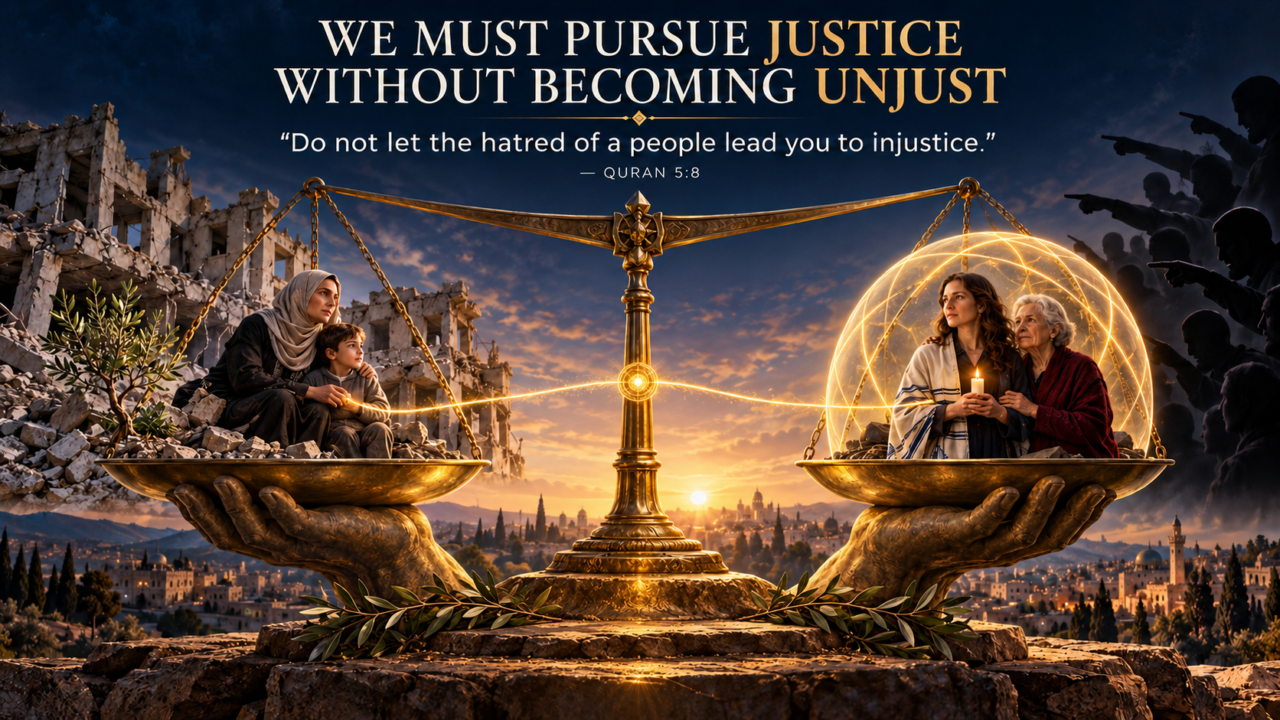
This may be the hardest assignment of all. Anger at oppression can be legitimate and morally necessary. Indifference to suffering is not peace. But when anger strips us of fairness, it begins to reproduce the same moral failure we claim to resist. Justice loses its soul when it adopts the language and methods of prejudice.
What is happening in Gaza may lead some to harbor ill will towards Jews. However, this attitude is misguided; it is not Jews or Judaism as a whole. We must recognize that individual actions drive both the good and the evil in the world. For example, Netanyahu carries the responsibility for the suffering and genocide of the Palestinians. It is important to confront any biases we may have against Jews, Judaism, or anyone else. Hatred only erodes our peace, and we can choose to break free from it or remain burdened by it.
Netanyahu has put Jewish lives in jeopardy, and I empathize with their fear whenever they travel anywhere in the world. It is crucial for my fellow humans, especially the Jewish community, to urge him to resign before further harm occurs. I encourage my Jewish friends to consider how 90% of the world views the situation, rather than focusing solely on the propaganda that aims to appease their fears. It’s important to recognize that this perspective is shared by the entire world, except for a few.
The moral principle is clear: responsibility must be assigned to those who formulate, authorize or carry out wrongdoing. It must not be transferred to an entire religion, ethnicity or population. We must be able to defend the dignity and rights of Palestinians without treating Jews elsewhere as collectively guilty. Condemning injustice must never become permission to commit another injustice.
The Quran commands justice most emphatically when anger, loyalty or prejudice might tempt us away from it:
“Do not let the hatred of a people lead you to injustice. Be just! That is closer to righteousness.”
—Quran 5:8
It then requires us to apply the same moral standard even when doing so may be personally difficult:
“Stand firm for justice … even if it is against yourselves, your parents, or close relatives.”
—Quran 4:135
The Quran also distinguishes between those responsible for hostility and those who have committed no aggression:
“Allah does not forbid you from dealing kindly and fairly with those who have neither fought nor driven you out of your homes.”
—Quran 60:8
This moral demand is not confined to one religion. The Bhagavad Gita praises the person who develops an impartial mind toward friends and enemies, the righteous and the sinful:
“He who regards with an equal eye well-wishers, friends, foes … and even the good and the sinful—he excels.”
—Bhagavad Gita 6:9
The Torah commands judges to resist favoritism in every direction:
“You shall not render an unfair decision: do not favor the poor or show deference to the rich; judge your kindred fairly.”
—Leviticus 19:15
The Christian scriptures express the same principle with equal directness:
“If you show favoritism, you sin and are convicted by the law as lawbreakers.”
—James 2:9
Gandhi took this discipline of learning across religious traditions seriously. During his periods of imprisonment, he studied the Quran, the Bhagavad Gita, the Bible and writings from several other faiths. He did not read these scriptures merely to collect quotations. He searched them for moral truths that could be practiced in moments of anger, fear and conflict.
That is the challenge before us now.
The true test of our commitment to justice is not whether we can be fair to those we love. It is whether we can remain fair when confronting those whose actions anger us. We must condemn wrongdoing without condemning ancestry, oppose governments without hating populations, and pursue accountability without manufacturing collective guilt.
Justice must be strong enough to confront oppression—and disciplined enough not to become oppressive itself.
Gandhi’s Question for Every Reader
Gandhi was killed in 1948, but the conditions that make his message necessary remain with us. Religion is still manipulated for power. Political language still turns neighbors against one another. Minorities are still asked to prove that they belong. Parents still pass unresolved fears to their children.
That is why Gandhi’s birthday cannot be merely ceremonial.
A statue can remind us of a life, but it cannot live that life for us. A quotation can inspire us, but it cannot change how we treat another human being. The spinning wheel, the Salt March and the image of Gandhi walking with a staff matter only if they move us toward our own acts of conscience.
When I remember Gandhi’s hand on my back and the words, “Son, you have a lot of work to do,” I no longer hear them as a message intended for me alone.
I hear them addressed to all of us.
The work before us is to challenge prejudice without becoming prejudiced, pursue justice without surrendering compassion and defend our convictions without denying another person’s dignity.
It is to build homes in which children are not taught whom to hate, communities in which differences do not become threats and nations in which no citizen must live in fear of another.
On Gandhi Jayanti 2026, the question is not simply whether we admire Mahatma Gandhi.
The question is whether we are prepared to continue the work.
What will you do?
Mahatma Gandhi inspires Mike Ghouse
Groundbreaking Ceremony of Mahatma Gandhi Memorial Plaza in Thomas Jefferson Park, Irving, Texas.
https://centerforpluralism.com/ground-breaking-ceremony-mahatma-gandhi-memorial-plaza-thomas-jefferson-park-irving-texas/
Mahatma Gandhi’s message
https://centerforpluralism.com/mahatma-gandhis-message/
Mahatma Gandhi: Do not poison your children
What can we do for the next 250 years?
For the Center for Pluralism, this is America’s new frontier: strengthening a nation in which our differences do not divide us, but become a source of understanding, cooperation, and collective strength.
America at 250 — Leading the World Through Pluralism:
https://centerforpluralism.com/america-at-250-leading-the-world-through-pluralism/
Dr. Ghouse is the President and founder of the Center for Pluralism and director of the World Muslim Congress. He is an Interfaith Wedding Officiant for InterfaithMarriages.org and a Muslim Wedding Officiant. He is a Muslim, Pluralist, activist, speaker, author, and social scientist. He is also a member and supporter of Muslims for Progressive Values (MPVUSA). More on Google
Latest Articles about Mike Ghouse
1. New York Times on a Wedding Officiated by Mike Ghouse: on a wedding I officiated
2. Mr. Pluralist of America – Mr. Pluralist of America
3. A Heart that connects – A Lamp that connects hearts
4. Mission Accomplished – Mission Accomplished Dallas-Washington-Dallas
5. Background of Mike Ghouse Background of Mike Ghouse
7. America’s New Frontier: America’s new frontier for the next 250 years
8. More at https://interfaithmarriages.org/about-mike-ghouse/