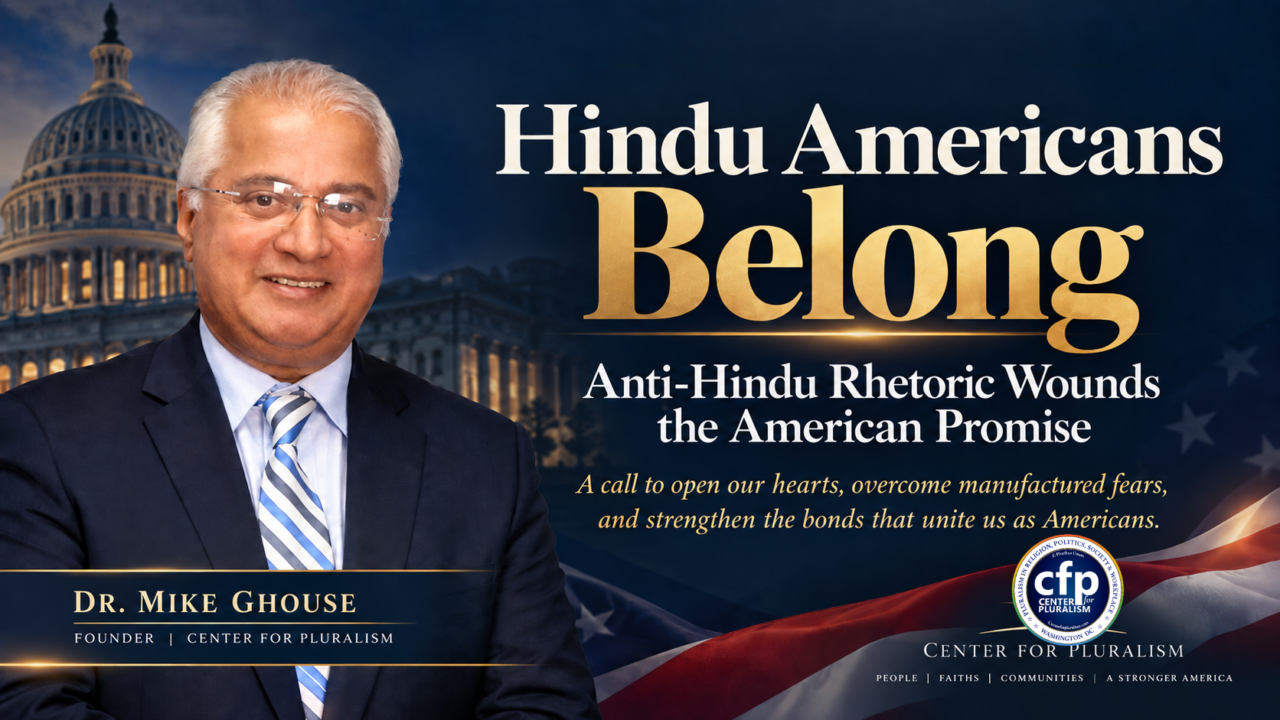
A call to open our hearts, overcome manufactured fears, and strengthen the bonds that unite us as Americans
There is a troubling harshness entering our public discourse. Hindu identity, along with Muslim and Jewish identities, is increasingly being turned into an object of suspicion, fear, and political rhetoric. When any American is made to feel like a foreigner because of their name, faith, appearance, or heritage, our entire nation is diminished.
This statement is not intended to deepen divisions or trade one accusation for another. It is an invitation to open our hearts and minds.
Some of our fellow Americans have been led to fear that Indians, Hindus, Muslims, and other minority communities are somehow “taking over” local governments, educational institutions, technology companies, and other parts of American life. But participating in America is not taking over America. It is the fulfillment of the American promise.
There was a time when Baptists, Catholics, Jews, and other communities were viewed with similar suspicion. Each generation is given the opportunity to rise above the fears inherited from the past. This is our opportunity.
Hindu Americans are not strangers at the American table. They are our neighbors, friends, physicians, teachers, entrepreneurs, scientists, public servants, and members of our families. They work, worship, raise their children, serve their communities, and contribute to the well-being of this nation. Yet their right to dignity and belonging does not depend only on what they contribute. They belong because they are Americans.
Standing with Hindu Americans does not require standing against anyone else. Compassion is not a limited resource, and dignity is not something we must take from one community to give to another. When we stand against anti-Hindu prejudice, Islamophobia, antisemitism, racism, and every effort to make our neighbors feel unwelcome, we strengthen the same principle: every human being deserves respect.
Religious freedom has meaning only when it includes the freedom of people whose beliefs and forms of worship may differ from our own. Some experience the Divine through sacred images and traditions; others through scripture, prayer, contemplation, service, or an understanding beyond form. Some do not profess a religion at all. Another person’s prayer takes nothing away from ours. Their freedom strengthens our freedom.
At the Center for Pluralism, we have seen what happens when people move beyond assumptions and meet one another as human beings. Suspicion begins to soften. Strangers discover common ground. People who once stood apart learn to share their stories, respect their differences, and work together for the common good. This is how a cohesive society is built—not by erasing our differences, but by learning to live with them respectfully.
The antidote to prejudice is meaningful human connection. I urge every American to invite people of different races, ethnicities, religions, cultures, and political perspectives into the ordinary moments of life—birthday celebrations, weddings, anniversaries, neighborhood gatherings, meals, and conversations. When we know one another personally, fear loses its power over us.
America is a microcosm of the world. Nearly every race, religion, ethnicity, language, and culture has found a home here. This remarkable diversity is not a weakness to be feared; it is a national treasure to be protected. Our Constitution binds us through a shared commitment to freedom and equality, and our humanity binds us through hopes that are more alike than different.
No American should be made to feel like a guest in the country they call home. Hindu Americans are an inseparable part of the American family, and their safety, dignity, and freedom concern us all.
Let us not allow manufactured fears to rob us of our peace or turn neighbors against one another. Let us respond with understanding, friendship, and moral courage. Let us forgive those who do not yet understand while continuing to open doors, build relationships, and bring people together.
We are many communities, but we are one people. We may worship differently, vote differently, speak differently, and carry different histories—but we share one home and one future.
Let us preserve the beauty of America by ensuring that every American can say, without hesitation or qualification:
I belong here.
What can we do for the next 250 years?
For the Center for Pluralism, this is America’s new frontier: strengthening a nation in which our differences do not divide us, but become a source of understanding, cooperation, and collective strength.
America at 250 — Leading the World Through Pluralism:
https://centerforpluralism.com/america-at-250-leading-the-world-through-pluralism/
Dr. Ghouse is the President and founder of the Center for Pluralism and director of the World Muslim Congress. He is an Interfaith Wedding Officiant for InterfaithMarriages.org and a Muslim Wedding Officiant. He is a Muslim, Pluralist, activist, speaker, author, and social scientist. More on Google
Latest Articles about Mike Ghouse
1. New York Times on a Wedding Officiated by Mike Ghouse: on a wedding I officiated
2. Mr. Pluralist of America – Mr. Pluralist of America
3. A Heart that connects – A Lamp that connects hearts
4. Mission Accomplished – Mission Accomplished Dallas-Washington-Dallas
5. Background of Mike Ghouse Background of Mike Ghouse
7. America’s New Frontier: America’s new frontier for the next 250 years
8. More at https://interfaithmarriages.org/about-mike-ghouse/