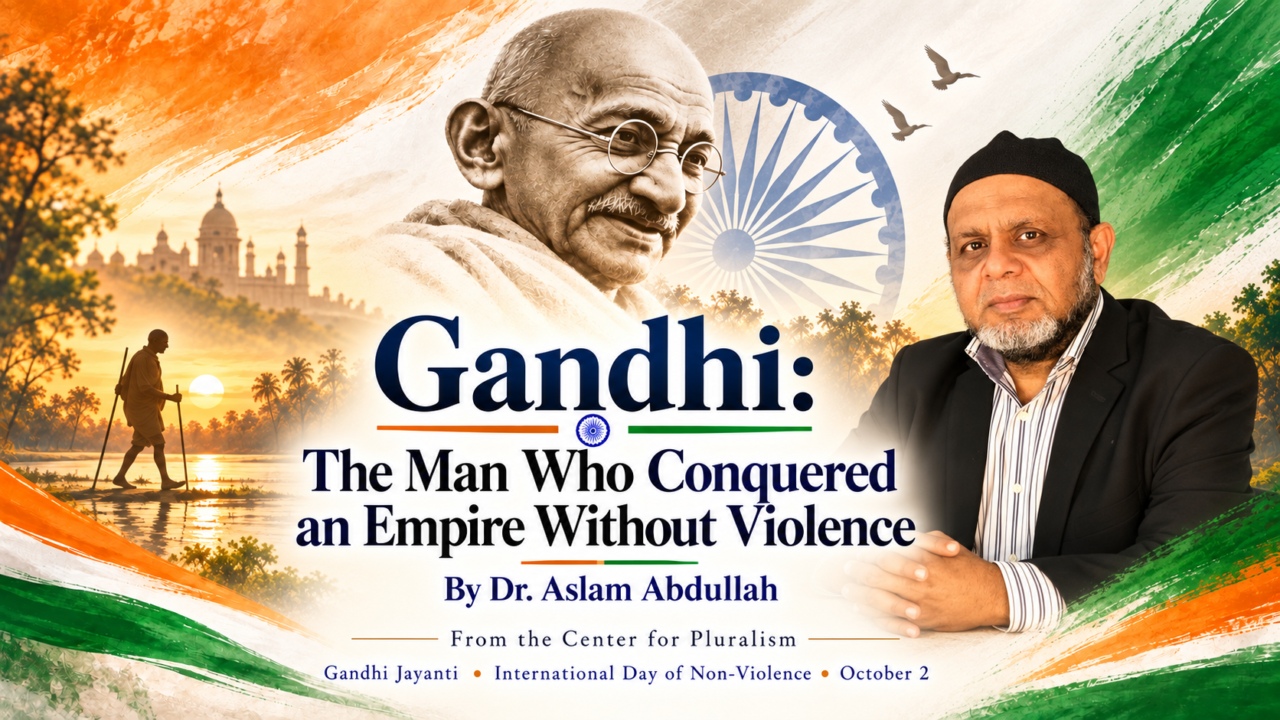
By Dr. Aslam Abdullah, with a personal reflection from Dr. Mike Mohamed Ghouse
From the Center for Pluralism
As the world observes Gandhi Jayanti and the International Day of Non-Violence on October 2, the Center for Pluralism is honored to share this reflection by Dr. Aslam Abdullah.
Mahatma Gandhi’s legacy is not confined to the history of India’s independence. It lives wherever people confront injustice without surrendering their humanity, where faith becomes a source of compassion rather than division, and where moral courage proves stronger than violence.
Dr. Abdullah’s essay revisits the life, assassination, and enduring moral influence of a man who faced an empire without an army and pursued freedom without allowing patriotism to become hatred. Following the essay, Dr. Mike Mohamed Ghouse shares the deeply personal connection between Gandhi’s example and his own calling to build cohesive societies.
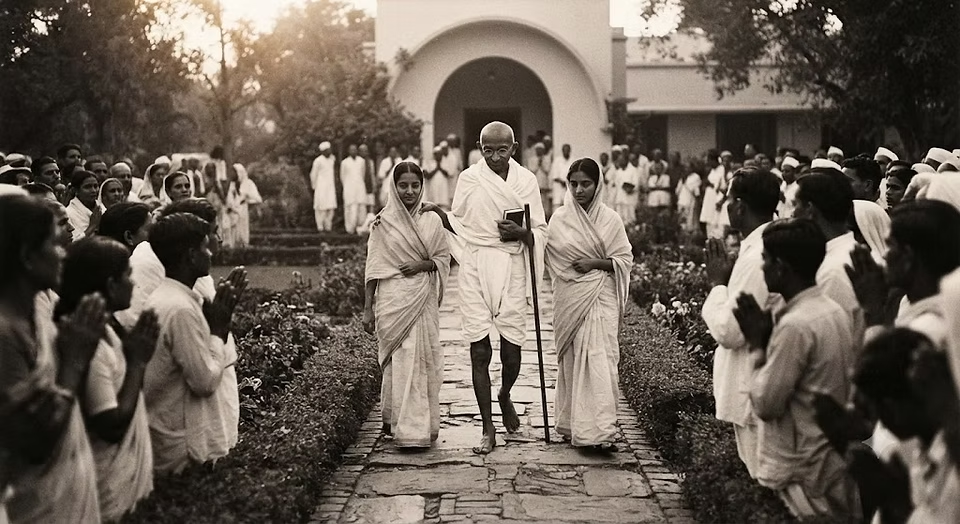
They killed him on his way to prayer. He carried no weapon. He commanded no army. He sought no throne. Wrapped in a simple homespun shawl, leaning upon his walking stick, Mohandas Karamchand Gandhi walked toward the prayer gathering as he had done countless times before. Then came the sound of three gunshots, and one of history’s greatest moral voices fell silent.
As he collapsed, the words remembered by many witnesses were: “Hey Ram.” “O Lord Rama.” There are moments in history so filled with irony that they seem almost beyond human imagination. The assassin believed he was defending Ram, protecting Hindu civilization, and serving the cause of a Hindu Rashtra.
The man he murdered entered eternity with Ram upon his lips. One invoked the name of Ram to justify killing. The other uttered the same name as a prayer of surrender, forgiveness, and eternal peace. No contrast could reveal more clearly the difference between religion as an instrument of hatred and religion as a path toward God.
Gandhi spent his entire public life refusing to hate. He did not hate those who imprisoned him. He did not hate those who mocked him. He did not hate those who exploited his country. He did not hate those who beat his followers. He did not even hate those who disagreed with him.
His revolution was unlike any the modern world had witnessed. While other nations sought freedom through rifles and battlefields, Gandhi challenged one of history’s mightiest empires armed only with truth, conscience, fasting, prayer, and disciplined nonviolence.
He transformed ordinary men and women into participants in one of humanity’s greatest moral revolutions. Salt became an instrument of resistance. A spinning wheel became a declaration of economic independence. Peaceful marches became stronger than imperial armies.
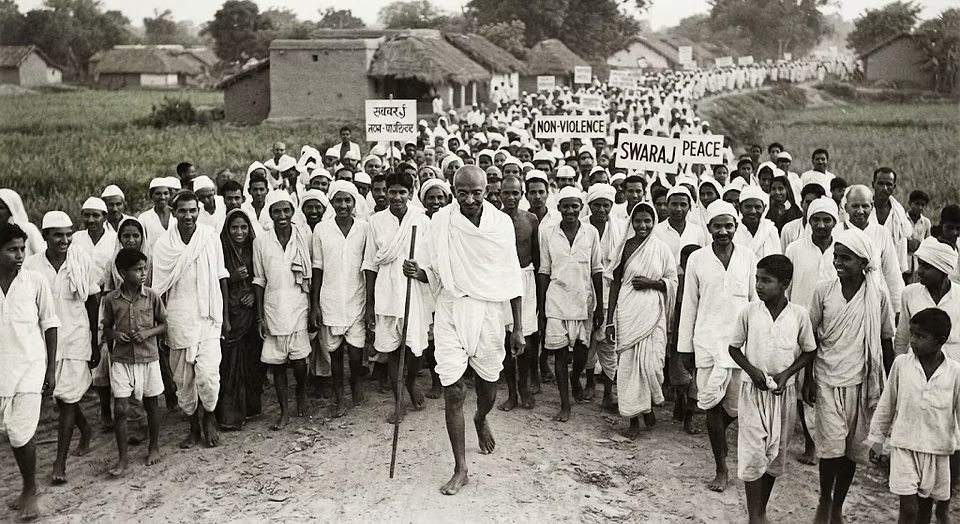
The British Empire imprisoned him repeatedly. It tried to weaken him, isolate him, and silence him. Yet every prison sentence seemed only to enlarge his moral authority. The empire eventually departed, but Gandhi’s influence crossed every frontier.
Then came the tragedy that no one expected. The empire did not kill Gandhi. History records that he was assassinated by one of his own countrymen, a man convinced that Gandhi had betrayed Hindu interests through his efforts to protect India’s Muslim minority and preserve communal harmony. Yet history also teaches humility.
Not every question is answered in the lifetime of those who ask it. Perhaps one day, forgotten archives will be opened. Perhaps private correspondence, intelligence files, or documents still hidden from public view will reveal dimensions of those turbulent years that remain unknown today. Or perhaps they will reveal nothing at all.
To suggest such possibilities is not to rewrite history but to acknowledge that history is often incomplete until new evidence emerges. Whether or not any such evidence is ever found, one painful truth remains beyond dispute: the greatest obstacle standing before the politics of hatred was removed not by a foreign bullet, but by an Indian hand.
That is the tragedy. That is the heartbreak. That is the irony.
The man who devoted his life to uniting Hindus and Muslims fell before someone who believed India belonged to only one religious community. The man who preached that every human being carries the image of God died at the hands of someone who believed that religious identity could justify murder. The man who refused to answer violence with violence became the victim of violence itself.
Yet Gandhi’s life cannot be measured merely by the manner of his death. His contribution belongs to humanity. He transformed politics into moral action. He reminded the world that the strongest weapon is not fear but conscience. He demonstrated that genuine courage is found not in taking life but in risking one’s own life for truth.
His philosophy of Satyagraha inspired movements across continents. Martin Luther King Jr. carried Gandhi’s message into the struggle for civil rights in the United States. Nelson Mandela drew strength from his example in the long battle against apartheid. Countless advocates of justice, reconciliation, and peace continue to find in Gandhi proof that moral authority can outlive political power.
Gandhi’s universalism was rooted in a profound spiritual conviction. He believed that no nation could become truly free by humiliating another. No religion could honor God by degrading God’s children. No civilization could claim greatness while denying the dignity of those who differed from it.
His patriotism never became hatred. His faith never became exclusive. His love for India never required him to despise anyone else.
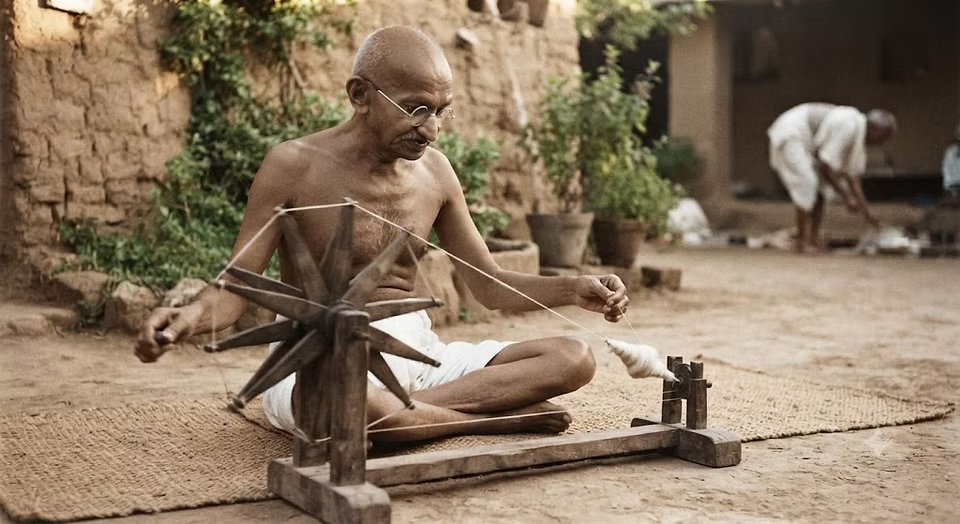
That is why Gandhi belongs not only to India but to the moral inheritance of humanity. His assassins stopped his heartbeat. They could not stop his journey.
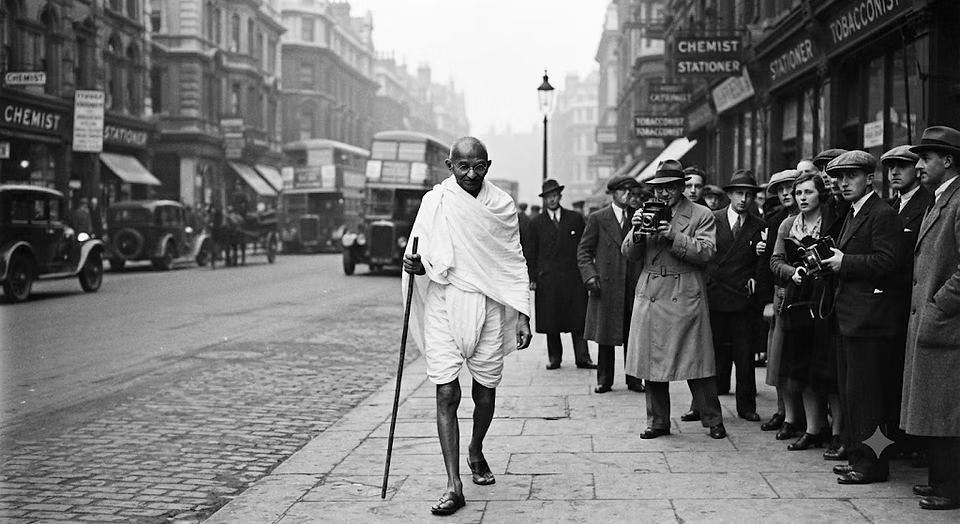
Empires disappear. Governments change. Ideologies fade. But a frail old man walking toward prayer, whispering “Hey Ram” with his final breath, continues to ask every generation a question that no bullet can silence:
Can love remain stronger than hatred? Can truth outlive violence? Can conscience still defeat power?
As long as humanity continues to struggle with these questions, Gandhi will continue to walk among us.
A Personal Reflection from Dr. Mike Mohamed Ghouse
Dr. Mike’s connection with Gandhi is neither ceremonial nor abstract. He regards Mahatma Gandhi as one of the people who most profoundly shaped his life and sees nonviolence as a practical moral discipline—one capable of moving conflict away from vengeance and toward dialogue, justice, and lasting peace.
Gandhi’s example also informs the Center for Pluralism’s commitment to building cohesive societies in which people respect the otherness of others and accept the uniqueness of every human being.
“Mahatma Gandhi is one of my greatest inspirations. He appeared in my dreams twice—in the early 1970s and again in 1993. In one of those dreams, he placed his hand on my back and said, ‘Son, you have a lot of work to do.’ I understood those words as a call to build cohesive societies. That calling led to the establishment of the Foundation for Pluralism, which later became the Center for Pluralism.”
—Dr. Mike Mohamed Ghouse
Gandhi’s life reminds us that nonviolence is not passivity and reconciliation is not surrender. They require the courage to confront injustice without becoming consumed by hatred—and the moral imagination to seek a future in which former opponents can live together without fear.
That unfinished work belongs to all of us.
Dr. Aslam Abdullah is an American Muslim scholar, author, Imam, and activist who writes and speaks widely on Islam, interfaith relations, and community issues.
Mahatma Gandhi inspires Mike Ghouse
https://www.youtube.com/watch?
Groundbreaking Ceremony of Mahatma Gandhi Memorial Plaza in Thomas Jefferson Park, Irving, Texas.
https://centerforpluralism.
Mahatma Gandhi’s message
https://centerforpluralism.
Mahatma Gandhi: Do not poison your children
Gandhi, let’s adopt him as an American
https://centerforpluralism.com/gandhi-lets-adopt-him-as-an-american/
Gandhi on Tolerance by Sam Madden
https://centerforpluralism.