Celebrating Sri Krishna, the Bhagavad Gita, and the Spirit of Pluralism
By Dr. Mike Ghouse
Updated for Janmashtami 2026 from my reflection originally published in HuffPost in 2012.
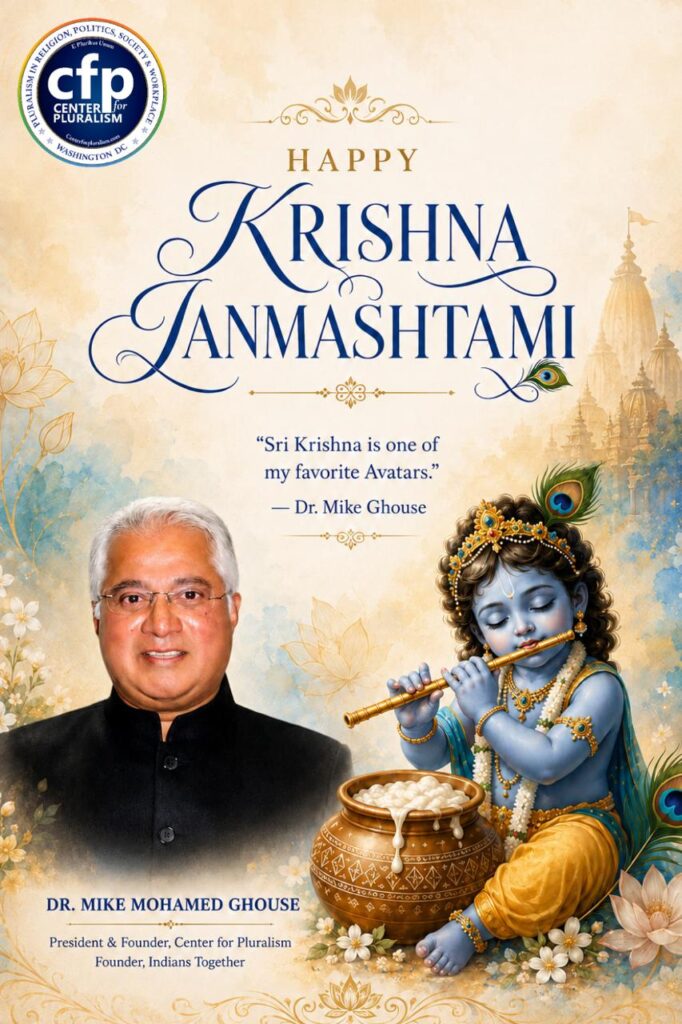
As we celebrate the joyous occasion of Krishna Janmashtami, I find myself once again reflecting on one of the great spiritual figures who has influenced my thinking: Sri Krishna.
Janmashtami commemorates the appearance, or birth, of Sri Krishna. In Hindu tradition, Krishna is revered as the eighth avatar of Vishnu and is one of the most beloved figures in Hindu spiritual life.
For millions of people around the world, Janmashtami is a day of devotion, prayer, fasting, music, celebration, and remembrance. For me, it is also an opportunity to revisit the extraordinary wisdom associated with Krishna—particularly the teachings of the Bhagavad Gita—and to reflect upon what those teachings can offer all of humanity.
So today I say with joy and respect:
Happy Janmashtami. Janmashtami Mubarak!
Sri Krishna and the Meaning of Janmashtami
Hindu thought encompasses many ways of understanding and approaching the Divine. Brahma is traditionally associated with creation, Vishnu with preservation, and Shiva with transformation and dissolution.
Sri Krishna is traditionally understood as an avatar of Vishnu and therefore embodies, among many other qualities, the restoration and preservation of dharma—the moral and spiritual order that enables life and society to remain in balance.
Some devotees, particularly within the Hare Krishna tradition, prefer to speak of Krishna’s divine appearance rather than simply his birthday. Whatever terminology one chooses, Janmashtami provides an occasion to remember what Krishna represents and what his teachings continue to mean to people across the world.
At the heart of those teachings is the Bhagavad Gita.
The Bhagavad Gita: Wisdom for the Struggles of Life
The Bhagavad Gita unfolds as a conversation between Krishna and the warrior Arjuna.
Arjuna stands on the battlefield of Kurukshetra facing an extraordinary moral crisis. He is confused about duty, action, morality, relationships, consequences, and the meaning of doing what is right.
That setting has always fascinated me because the battlefield can also be understood as a powerful metaphor for the struggles taking place within each human being.
We all encounter our own Kurukshetras.
We wrestle with fear. We question our decisions. We struggle between personal interest and responsibility. We wonder when to act, when to remain patient, what is just, and what our obligations are toward others.
Krishna’s dialogue with Arjuna therefore reaches far beyond one historical or religious setting. It raises questions that human beings continue to ask today.
One of the Gita’s most celebrated teachings appears in Bhagavad Gita 4:7–8, where Krishna speaks of appearing when dharma declines and adharma rises, for the protection of the righteous and the restoration of dharma.
I have always been drawn to the idea behind those verses: when imbalance takes root, balance must be restored.
That principle is not merely theological. It can become a principle for living.
When hatred disrupts a community, we have a responsibility to restore understanding. When injustice disturbs society, we must work toward justice. When fear separates people, somebody must have the courage to build trust.
Restoring balance is something each of us can participate in.
Why Sri Krishna Became One of My Mentors
My admiration for Sri Krishna is deeply personal.
For many years, I have regarded Krishna as one of the spiritual teachers and mentors from whom I continue to learn.
The Quran teaches that messengers were sent among the nations and communities of humanity. As a Muslim committed to pluralism, that teaching has encouraged me to approach other traditions with curiosity rather than fear and to recognize wisdom wherever I encounter it.
In my own interfaith understanding, I see in Sri Krishna a great divine guide whose teachings call human beings toward responsibility, righteousness, balance, and peace.
That does not create confusion about my own faith.
I am a Muslim, and I worship God alone.
My admiration for Krishna, Jesus, Buddha, Guru Nanak, and other teachers does not require me to surrender my Muslim identity. On the contrary, learning about other traditions has repeatedly challenged me to understand my own faith more deeply.
That is one of the gifts of genuine interfaith engagement.
How the Bhagavad Gita Led Me Back to Islam
Today, I am a Muslim because of Bhagavad Gita, and I have written extensively about it and have recorded on several videos, one of them in this video. One of the most important ideas I took from my reading of the Bhagavad Gita was the importance of accepting responsibility for seeking truth.
That principle had a profound effect on my life.
It encouraged me to question, examine, study, and think critically instead of simply accepting beliefs because someone else had handed them to me.
Ironically—or perhaps beautifully—that process helped lead me back to Islam.
I have often said that the Bhagavad Gita played an important role in making me the Muslim I am today.
It taught me not to fear questions.
Truth does not become weaker when questioned sincerely. Faith does not have to depend on ignorance of another person’s faith.
Learning can deepen conviction.
Sacred Wisdom Does Not Have to Be Locked Behind Religious Boundaries
This is why I have long encouraged people to read beyond the boundaries of their own traditions.
The Bhagavad Gita, Quran, Bible, Torah, Guru Granth Sahib, Avesta, and the sacred literature of the world’s many religious traditions contain wisdom that can help human beings think about justice, compassion, responsibility, humility, service, and our relationship with one another.
A Christian can learn something from the Gita without becoming Hindu.
A Muslim can appreciate the teachings of Jesus without ceasing to be Muslim.
A Hindu can discover wisdom in the Quran without surrendering Hindu identity.
A Sikh, Jew, Buddhist, Jain, Bahá’í, Zoroastrian, atheist, agnostic, or person of another tradition can encounter an idea outside his or her own background and allow that idea to expand their understanding.
Recognizing goodness in another tradition does not diminish the goodness of our own.
That, to me, is the essence of pluralism.
The World Is One Family
Indian civilization has given humanity a beautiful expression:
Vasudhaiva Kutumbakam — the world is one family.
The expression comes from the Maha Upanishad, and its message has become deeply associated with India’s pluralistic philosophical heritage.
What an extraordinary idea.
The person standing across from me may speak another language, worship differently, belong to another race, carry another nationality, or understand God differently—but that person remains part of the human family.
Pluralism does not mean eliminating our differences.
It means learning to live respectfully with those differences.
Our identities do not have to disappear. We can be Muslim, Hindu, Christian, Jewish, Sikh, Buddhist, Jain, Bahá’í, Zoroastrian, or belong to any other tradition and still recognize the dignity of the person standing next to us.
The goal is not sameness.
The goal is coexistence with dignity.
India’s Extraordinary Religious Diversity
India’s religious landscape offers one of the world’s most remarkable examples of diversity.
Hinduism, Buddhism, Jainism, and Sikhism originated on the Indian subcontinent. Over many centuries, Jewish, Christian, Muslim, Zoroastrian, Bahá’í, and other communities also became part of India’s religious and cultural landscape.
This diversity is not always easy. No diverse society is without tensions.
But diversity also provides an extraordinary opportunity: people who believe differently can learn how to live together rather than merely tolerate one another from a distance.
Our religions should help us become better human beings and better neighbors.
If our religiosity increases our hatred for another person, then something has gone wrong in how we understand religion.
A Childhood Memory of Krishna
My connection with Krishna also reaches all the way back to childhood.
When I was a little boy, I was once dressed as baby Krishna. A matka, or clay pot, filled with makhan—butter—was placed in front of me.
Apparently, I behaved just as the stories of little Krishna suggested I should.
I went after the butter with my bare hands and ate it.
Pictures were taken, and for years those photographs could be found in the homes of family and friends.
It is one of those memories that makes my relationship with Krishna’s story not merely intellectual, but affectionate and personal.
Mathura and Vrindavan
I have also had the privilege of visiting Vrindavan, a place inseparably connected with Krishna’s childhood and youth.
According to Hindu tradition, Krishna was born in Mathura and spent important parts of his childhood in the region of Vrindavan.
Being there was profoundly moving.
There is something powerful about standing in places that generations of people have associated with a person whose teachings have transformed so many lives.
I walked through Vrindavan, listened to the devotional music, visited sacred places, and reflected on Krishna’s extraordinary influence across centuries.
And yes, I also went searching for Krishna songs.
I remember walking around trying to find recordings of songs sung by the great voices I remembered. I encountered newer versions but wanted the originals. Eventually, after considerable searching, I found what I was looking for.
Music, memory, spirituality, and place all came together.
Studying the Gita in Dallas
My engagement with the Bhagavad Gita was not limited to occasional reading.
In Dallas, I had the opportunity to learn from Swami Nityananda Prabhu of the Hare Krishna Temple, whose approach to Krishna’s teachings resonated with my own interest in pluralism.
For roughly two years, we explored the Bhagavad Gita on my radio program, meeting the text week after week and discussing its wisdom.
Those conversations were part of a larger commitment I have maintained throughout my life: learning about every beautiful religious tradition directly and respectfully.
The more we know about one another, the less room we leave for manufactured fear.
Krishna’s Message of Action
Another teaching associated with Krishna that has remained with me is the call to perform one’s responsibility without becoming consumed by the reward.
Do the work that must be done.
Do what is right.
Do not allow obsession with the fruits of your actions to control the action itself.
That principle speaks powerfully to our modern world, where success is so often measured through recognition, money, influence, applause, followers, and status.
Sometimes the right thing must be done simply because it is the right thing.
That is a lesson worth remembering on Janmashtami—and every day.
Learning Across Traditions
Throughout my life, I have tried to learn from many teachers and leaders.
Krishna, Jesus, Buddha, Prophet Muhammad, Guru Nanak, Bahá’u’lláh, Ali, Mahatma Gandhi, Martin Luther King Jr., the Aga Khan, Rev. Sun Myung Moon, Barack Obama, and many others have, in different ways and different contexts, offered ideas worth examining.
Learning from someone does not require agreeing with everything that person ever said or did.
It requires the humility to recognize wisdom when we encounter it.
The world needs more of that humility.
Janmashtami and the Challenge Before Us in 2026
Fourteen years have passed since I first published my reflections on Janmashtami in HuffPost in 2012.
Much has changed.
Yet the challenge before humanity remains remarkably familiar.
How do we live together?
How do we prevent differences of religion, race, ethnicity, nationality, or politics from becoming excuses for hatred?
How do we restore balance when our societies become polarized?
How do we choose responsibility over anger, understanding over suspicion, and justice over revenge?
These are not merely Hindu questions, Muslim questions, Christian questions, Jewish questions, or Buddhist questions.
They are human questions.
And that is why the wisdom of Krishna still matters.
My Janmashtami Wish
On this Janmashtami, I invite my Hindu friends to celebrate with joy and devotion.
And I invite my Muslim, Christian, Jewish, Sikh, Buddhist, Jain, Bahá’í, Zoroastrian, atheist, agnostic, and other friends to learn something about why this day means so much to millions of our fellow human beings.
Pick up a copy of the Bhagavad Gita.
Read it not with the fear that another tradition might threaten your own, but with the confidence that understanding another person can enrich your own humanity.
Then read the Quran.
Read the Bible.
Read the Torah.
Read the Guru Granth Sahib.
Explore the wisdom of traditions different from your own.
The purpose is not conversion.
The purpose is understanding.
We do not have to become one religion to become one human family.
We simply have to learn how to honor the uniqueness of one another while recognizing the dignity we share.
On this beautiful occasion, I pay my respects to Sri Krishna, one of the great teachers who has inspired my journey.
May we learn from his call to responsibility.
May we restore balance wherever we find division.
May we build communities where no person has to live in fear of another.
And may we have the courage to see wisdom beyond the boundaries we inherit.
Happy Janmashtami!
Janmashtami Mubarak!
Some of My Favorite Krishna Songs
Music has always been an important part of my connection with Krishna. Some of the Krishna songs I included in my original Janmashtami reflection are:
- My favorite Janmashtami Song
- Murli Wale Murli Baja Suraiya in Dillagi
- Kanha Kanha aan padi my tere paas
- Radha kaisay na Jale
- Tere Bharosay ai nand lala
- Govinda Bolo Hari Gopala Bolo, my second favorite
- Radha Na Bole Na Bole Re – Azaad
- Mere Shyam Tera Naam
- Radhike tune bansari
- Darshan Do Ghanshyam Nath
- Madhuban mein radhika nache re
- Man Tarpat Hari Darsan ko Aaj
- Baat Nihare Ghanshyam
- Kanha too ne peer na janany
- Gokul ko choray gaye ghanshyam
Dr. Ghouse is the President and founder of the Center for Pluralism and director of the World Muslim Congress. He is an Interfaith Wedding Officiant for InterfaithMarriages.org and a Muslim Wedding Officiant. He is a Muslim, Pluralist, activist, speaker, author, and social scientist. More on Google
Latest Articles about Mike Ghouse
1. New York Times on a Wedding Officiated by Mike Ghouse: on a wedding I officiated
2. Mr. Pluralist of America – Mr. Pluralist of America
3. A Heart that connects – A Lamp that connects hearts
4. Mission Accomplished – Mission Accomplished Dallas-Washington-Dallas
5. Background of Mike Ghouse Background of Mike Ghouse
7. America’s New Frontier: America’s new frontier for the next 250 years
8. More at https://interfaithmarriages.org/about-mike-ghouse/