The Story of the Center for Pluralism
The Meaning of Pluralism
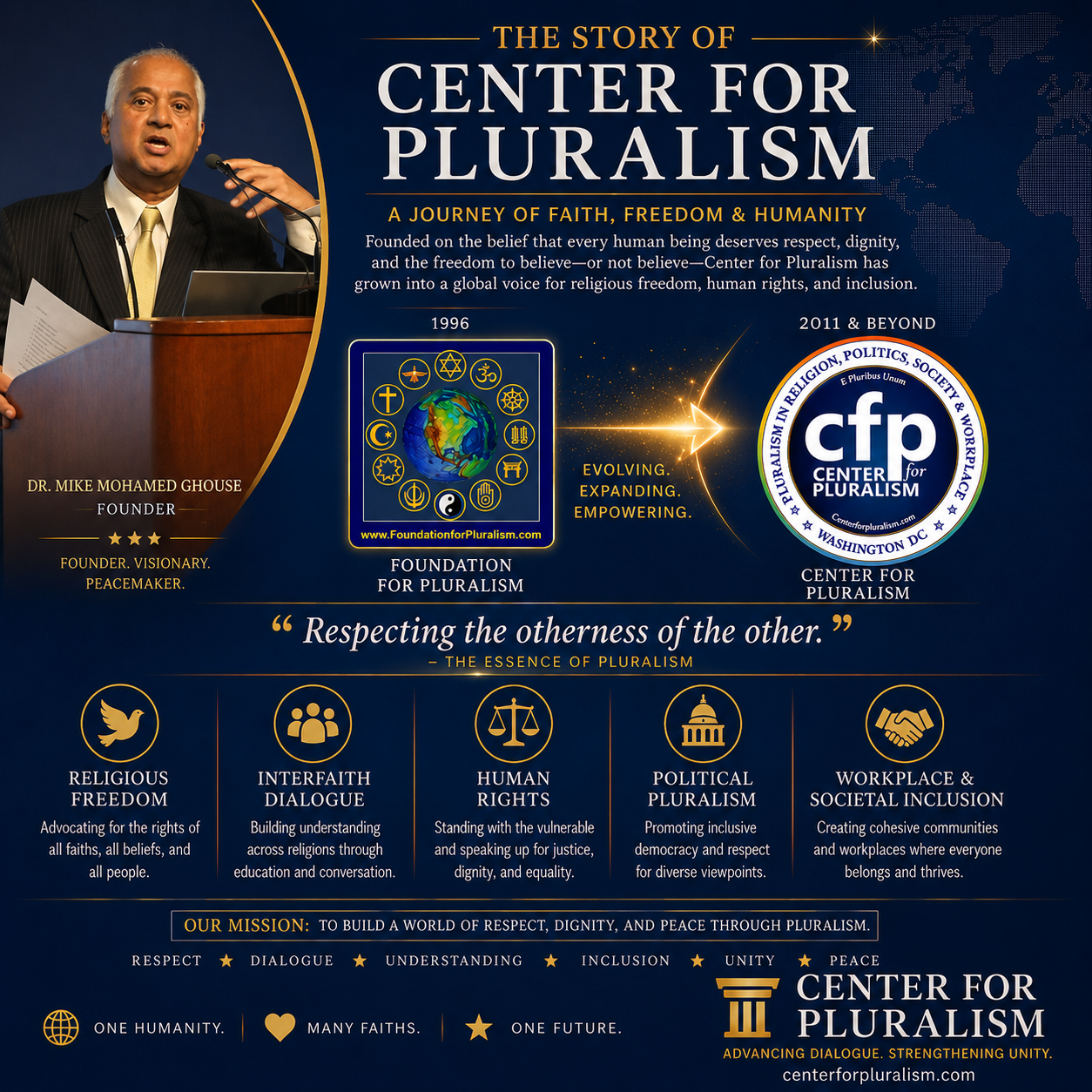
The term “Pluralism” gained traction in the mid-90s, though it has existed for centuries. At the Center for Pluralism, we define pluralism as “Respecting the otherness of the other.” This concept applies to religion, politics, society, and workplaces—every aspect of human interaction. Our mission also includes advocating for religious freedom and human rights worldwide.
The Birth of the Foundation for Pluralism
The Foundation for Pluralism came into being in 1993 alongside the launch of Asian News. This weekly publication promoted harmony among the different religions of South Asian nations, giving equal value to every faith—an approach that was not welcomed by religious conservatives.
Dr. Mike Ghouse, the founder of Pluralism, was denied membership at Thanksgiving Square in Dallas, Texas, one of the earliest interfaith organizations in the U.S. He was told he did not fit into a predefined religious category. At that time, he identified as an Agnostic, and this denial motivated him to create an organization that would welcome everyone, regardless of their faith or beliefs—with the exception of cannibals who might eat him up before he could even speak!
Consequently, the Foundation for Pluralism was formed in 1996, with a primary focus on religious pluralism. Its mission was to educate people and encourage mutual understanding and respect among various faiths and communities.
The Story Behind the Original Logo
When the Foundation for Pluralism was established in the 1990s, Dr. Mike Ghouse wanted a logo that genuinely reflected the spirit of pluralism — a world where every faith, belief, and community is treated with equal dignity and respect. With a simple concept in mind, he sketched his early ideas and shared them with an online design community, inviting others to help transform the vision into a meaningful symbol. A designer from the community responded and helped create what would become the original Foundation for Pluralism logo: a globe surrounded by symbols representing many of the world’s religions and philosophies.
Interestingly, the logo itself became one of the organization’s earliest lessons in pluralism. Some questioned why certain religious symbols appeared before others, and others asked why Islam was not placed first, especially since Dr. Ghouse is Muslim. His response reflected the very foundation of pluralism: if one faith is intentionally placed above another, then equality is lost. The purpose of the logo was never to rank religions, but to symbolize mutual respect, coexistence, and the belief that every individual deserves the freedom to practice — or not practice — their beliefs with dignity. In many ways, the logo became more than a design; it became a statement of the Center’s enduring commitment to inclusion and equal respect for all humanity.
Expanding the Vision to Religious, Political, and Societal Pluralism
Initially, the foundation focused on Religious Pluralism, welcoming people of all faiths—including Atheists, Baháʼís, Buddhists, Christians, Hindus, Jains, Jews, Muslims, Sikhs, Shintos, Wiccans, Zoroastrians, and others—to participate in its programs.
Over time, the foundation expanded into Political Pluralism and Societal Pluralism, addressing biases and fostering inclusion across all societal dimensions.
Following the tragic events of 9/11, the Foundation for Pluralism was renamed the Center for Pluralism. Its mission became even more critical, actively engaging in interfaith dialogue, conducting over 780 hours of radio talk shows, and organizing live workshops to explain the essence of various religious traditions—from Atheism to Zoroastrianism.
Promoting Interfaith Harmony through Radio and Workshops
One of the Center’s most significant contributions has been educating people about different religions. Through radio shows and workshops, the focus has always been on the essence of religious teachings, exploring fundamental religious questions such as:
- What does it mean when Jesus says, “Follow me”?
- Why does Krishna ask for surrender?
- What does Allah’s call for submission mean?
Instead of providing simple answers like “Because God or the scriptures said so,” the Center delved into deeper insights within each faith tradition.
Shared Values Across Religions
All faith traditions emphasize core human values that contribute to a fulfilling life and guide individuals in their daily actions. The moral principles across all traditions are similar:
- Healing the world
- Justice
- Charity
- Kindness to all life forms
We have a duty to restore harmony—God created everything in the universe in harmony, except for the free will given to us. It is our responsibility to restore peace whenever it is disrupted, a concept known as Islah al-Alam in Islam and Tikkun Olam in Judaism. Sri Krishna also emphasizes the importance of regaining righteousness.
Fundamental Values Across Religions
- Causer of the Universe – Recognizing an entity or energy responsible for the universe.
- Personal Accountability – Every individual is responsible for their actions.
- Caring for Others – Compassion fosters community support and well-being.
- Protecting the Environment – Climate change must be addressed for future generations.
- Interfaith Understanding – Learning about one another reduces biases and fosters harmony.
The True Meaning of Religious Pluralism
Religious pluralism means respecting another person’s beliefs as deeply as one respects their own.
However, this concept can be challenging due to religious exclusivity ingrained in many cultures. The Center for Pluralism teaches that embracing the validity of other faiths does not mean betraying one’s own religion; rather, it fosters peace and understanding, which are deeply embedded in each faith.
Challenges in Promoting Pluralism
Two significant surprises arose from our experience with a University in Dallas and Washington, DC:
- An Evangelical-run university resisted the idea that all religions should be considered valid.
- Many places of worship refused to even consider Atheism in interfaith workshops.
Ultimately, it was the Church of Scientology that sponsored these workshops, but many individuals still opposed the concept of pluralism.
Our philosophy is influenced by:
- Anekantavada (Jainism) – The belief in multiple perspectives.
- Vedantic Teachings (Hinduism) – “All rivers lead to the ocean.”
- Quranic Teachings (Islam) – Verse 109:6: “You have your religion, and I have mine.”
Official Recognition of the Center for Pluralism
On November 17, 2011, the IRS officially recognized the Center for Pluralism (America Together Foundation) as a 501(c)(3) non-profit organization.
The foundation’s principles align with the Rotary Club’s Four-Way Test:
- Is it the TRUTH?
- Is it FAIR to all concerned?
- Will it build GOODWILL and BETTER FRIENDSHIPS?
- Will it be BENEFICIAL to all concerned?
Workplace and Political Pluralism
In 2016, after attending a C-PAC meeting, the Center expanded its focus from religious pluralism to political pluralism.
Following the violent incidents in 2017, the Center further broadened its mission to include pluralism in the workplace, aiming to create cohesive work environments that benefit both individuals and organizations.
Building a Secure and Inclusive America
The Center for Pluralism envisions an America where everyone feels safe and respected, regardless of faith, ethnicity, race, political views, culture, or sexual orientation.
Annual Events That Promote Pluralism
The Center hosts several flagship events annually:
- Thanksgiving Celebrations (since 1996) – A dinner event promoting unity.
- Unity Day USA (since 2005) – An event dedicated to reinforcing national unity.
- Holocaust and Genocides Event (since 2006) – A commemoration of past atrocities.
- Festival of Faiths – Celebrating diverse religious traditions.
These events help reduce prejudice and foster mutual respect.
Embracing Conflict Resolution and Goodwill Nurturance
Inspired by Mother Teresa, the Center prioritizes dialogue over division. She famously said, “If you want to make peace with your enemies, talk with them.”
The Center actively engages with individuals from the far right and far left, bridging gaps and promoting mutual understanding.
Support the Center for Pluralism – Get Involved!
Join the movement and be a part of a more inclusive and harmonious world!
Recent News Items
Thanks to Dr. Indrajit Saluja of the Indian Panorama and Raja Zahid Khanzada of Jago Times for writing about:
- Mr. Pluralist of America
- A Lamp That Connects Hearts — A Radiant Journey of Love, Thought, and Service
- Everything about Mike Mohamed Ghouse
Who Is Dr. Mike Ghouse?
Dr. Ghouse is the President and founder of the Center for Pluralism and director of the World Muslim Congress. He is an Interfaith Wedding Officiant for InterfaithMarriages.org and a Muslim Wedding Officiant. He is a Muslim, Pluralist, activist, speaker, author, and social scientist. More on- Google