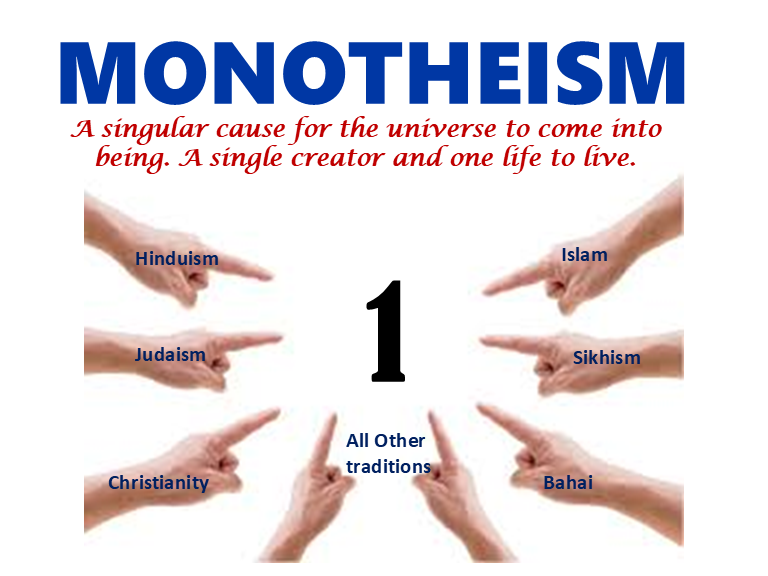
What is the significance of this monotheism?
The Universe did not come into existence on its own; something must have caused its emergence. Everything that humans understand can ultimately be traced back to a singular cause. Although we do not know exactly what that cause was, we have conceptualized a God to represent it.
The significance of monotheism lies in the idea of a singular cause. There is only one creator or God of creation. Even if we consider evolution, we might still regard the amoeba as the origin of life.
God, as understood in various religions, asks us to worship not for His benefit, but for our own peace. A mother’s love for her children exemplifies this. You may have seen a mother deer defending her fawn from a tiger, demonstrating how fiercely a mother protects her offspring. God is no different; He loves His creation, desires for us to live in peace, and offers guidance.
The purpose of worship is to clear the clutter from our minds and focus on specific concerns, thereby minimizing anxiety. The more precisely we articulate the help we need, the easier it becomes to seek that assistance. Ultimately, clarity brings peace. Have you ever found yourself with less tension when you list your concerns in bullets?
Monotheism, in this context, is defined as the belief in one God or creator, which stands in contrast to polytheism, the belief in multiple deities each worshipped for different purposes. Atheism, on the other hand, refers to the absence of belief in any specific creator.
Hinduism cannot simply be categorized as polytheistic because it involves the worship of various attributes of a singular God. This is similar to how Muslims seek names like Rahman, Rahim, Ghafoor, and Razak—representations of His 99 attributes (which signify infinite qualities)—depending on their specific needs at the moment. Belief in one God provides more straightforward guidance compared to the need to navigate multiple deities.
Monotheism Across Different Religions
Judaism, Christianity, Islam, Baha’i, and Sikhism
Judaism, Christianity, Islam, Baha’i, and Sikhism all believe in the existence of one God.
Hinduism
In contrast, Hinduism perceives God as manifesting in every form and attribute, recognizing one underlying cause of the universe.
Zoroastrianism, Buddhism, and Jainism
Zoroastrianism, Buddhism, and Jainism focus on the concept of karma, which means that when you do good deeds, you lead a peaceful and guilt-free life. Conversely, when you do wrong, you experience guilt, anxiety, and suffering, which many religions refer to as living in hell.
The Wisdom of Democracy and Monotheism
Consider the wisdom of democracy as expressed in our Declaration of Independence:
“That to secure these rights, governments are instituted among men, deriving their just powers from the consent of the governed.”
Now, imagine a God created through our consent.
The Purpose of Religion in Explaining God
To reduce confusion and foster cohesive societies where every individual feels secure, the sages of all religions have attempted to explain the concept of a creator, or God.
No religion is superior or inferior to another; any claim of superiority undermines the fundamental purpose of religion.
Religion should embody humility that builds bridges, while arrogance leads to conflict and destruction, which is not the goal of any faith.
Wisdom in All Religions
All religions contain profound wisdom. Your religion may be hereditary, or you may choose one that suits your mindset.
I have chosen Islam as my religion. Every religion works for the believer, bringing coherence and harmony both within and with others.
Monotheism and Building Peaceful Societies
No matter what your religious identity—a Hindu, Jew, Muslim, Christian, Buddhist, Sikh, Zoroastrian, or follower of another faith—if you are not actively working towards building peaceful societies for everyone, you are not fully embodying the principles of your belief.
Self-Reflection and Monotheism
Take a moment to reflect on this and ask yourself: Are you truly living up to your potential?
The Universe, Harmony, and Human Freedom
The entire universe is designed to function smoothly and in harmony. The only unpredictable elements are our interactions with one another.
We are blessed with the gift of freedom, which can either foster harmony between individuals, families, communities, and nations or lead to conflict.
Shared Moral Principles in All Religions
Moral principles across all traditions share similar values, emphasizing the importance of healing the world, justice, charity, kindness toward others, and ultimately following the right path.
Related Articles
Latest Articles About Mike Ghouse
- A Lamp That Connects Hearts: Dr. Mike Mohamed Ghouse — A Radiant Journey of Love, Thought, and Service
- Mr. Pluralist of America Panorama
- Background of Dr. Mike Mohamed Ghouse
About Dr. Mike Mohamed Ghouse
Dr. Ghouse is the President and founder of the Center for Pluralism and director of the World Muslim Congress.
He is an Interfaith Wedding Officiant for InterfaithMarriages.org and a Muslim Wedding Officiant. He is a Muslim, Pluralist, activist, speaker, author, and social scientist. More on Google.