Sri Ram: A Universal Cultural Icon Beyond Religion
Sri Ram is a figure revered by people of all faiths; he is our cultural icon, and we are all influenced by the Maryada Purushottam, as he is often called. As a Muslim, I view him as an integral part of our legacy and hold him in high regard among humanity’s great personalities. I grew up listening to Kathas (stories) in my hometown of Yelahanka, near Bangalore, and while in Dallas, I had the opportunity to hear Morari Bapuji at the Ekta Mandir. He highlighted all the virtues of Sri Ram.
Some narrow-minded individuals try to confine Sri Ram as if he were their personal property. However, no one truly owns Ram; instead, he belongs to all of us. Each of us can learn from the values he embodied and strive to follow them.
Sri Ram and the Ramayana: Ideals of Dharma and Virtue
Sri Ram, also known as Rama, is one of the most revered figures in Hinduism. He is celebrated as the embodiment of moral virtue, righteousness (dharma), duty, compassion, courage, and ideal leadership. Often referred to as Maryada Purushottama, meaning “the supreme man,” he upholds the highest standards of conduct and honor. His life and adventures are central to the ancient Hindu epic, the Ramayana, which is attributed to the sage Valmiki. This epic is one of the two major epics of Hinduism, the other being the Mahabharata. The story symbolizes the triumph of good over evil, emphasizes the importance of fulfilling one’s duty even in times of adversity, and highlights the power of devotion and loyalty.
AR Rahman and the Ramayana Film: Art Beyond Faith
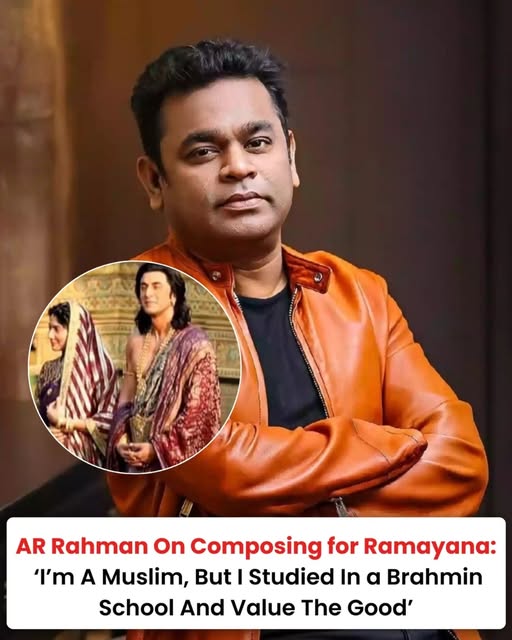
Music maestro A.R. Rahman recently discussed his work on the album for Nitesh Tiwari’s upcoming film, “Ramayana,” emphasizing that his faith did not hinder his connection to the project. He also shared insights about collaborating with Hans Zimmer on the film starring Ranbir Kapoor and Yash. We need to embrace a Muslim artist like Rahman as musical director for the epic “Ramayana,” as it highlights the universality of Sri Ram’s character. Rather than diminishing Ram, we should celebrate his significance.
Rahman’s Reflections on Knowledge, Virtue, and Inclusivity
In an interview with BBC Asian’s YouTube channel, Rahman was asked whether his religious beliefs influenced his composition process. Responding to this, he said, “I studied in a Brahmin school, and every year we had Ramayana and Mahabharata, so I know the story. The story is about how virtuous a person is, higher ideals, and all that stuff. People may argue, but I value all those good things — any good things that you can learn from. The prophet has said that knowledge is something invaluable, no matter where you get it from — a king, a beggar, a good act, or a bad one. You can’t shy away from things.”
A Message of Global Unity Through the Ramayan
He further reflected on the larger message of unity and growth, adding, “I think we need to elevate from small-mindedness and selfishness. Because when we elevate, and we become radiant, we become a radiant of that, and that’s very important. I am proud of the whole project, because it’s from India to the whole world, with such love. Hans Zimmer is Jewish, I am Muslim, and the Ramayana is Hindu.”
Dr. Ghouse is the President and founder of the Center for Pluralism and director of the World Muslim Congress. He is an Interfaith Wedding Officiant for InterfaithMarriages.org and a Muslim Wedding Officiant. He is a Muslim, Pluralist, activist, speaker, author, and social scientist. More on Google